
Sonoma County Arrest Reports
The Sheriff Arrest and Crime Logs page points to the county open-data portal. That portal covers current and historical arrest information. It is the strongest official starting point for a multi-day search in Sonoma County. It reaches well past the freshest same-day rows. Coverage depth stays undefined, though. The county promises no seventy-two-hour window, no seven-day cutoff, and no final archive date. Treat "historical" as an open label rather than a fixed range.
Rows can also carry more than one agency. Check the Full Agency Name field or its abbreviation before deciding who made an arrest. The Sheriff maintains the county dataset even when a city department appears in a row. And an arrest entry does not mean the person is still in the county jail. Custody has its own lookup.
The official arrest-and-crime logs landing page is Sonoma County's hub for arrest reports. It points visitors to broader arrest-log access.
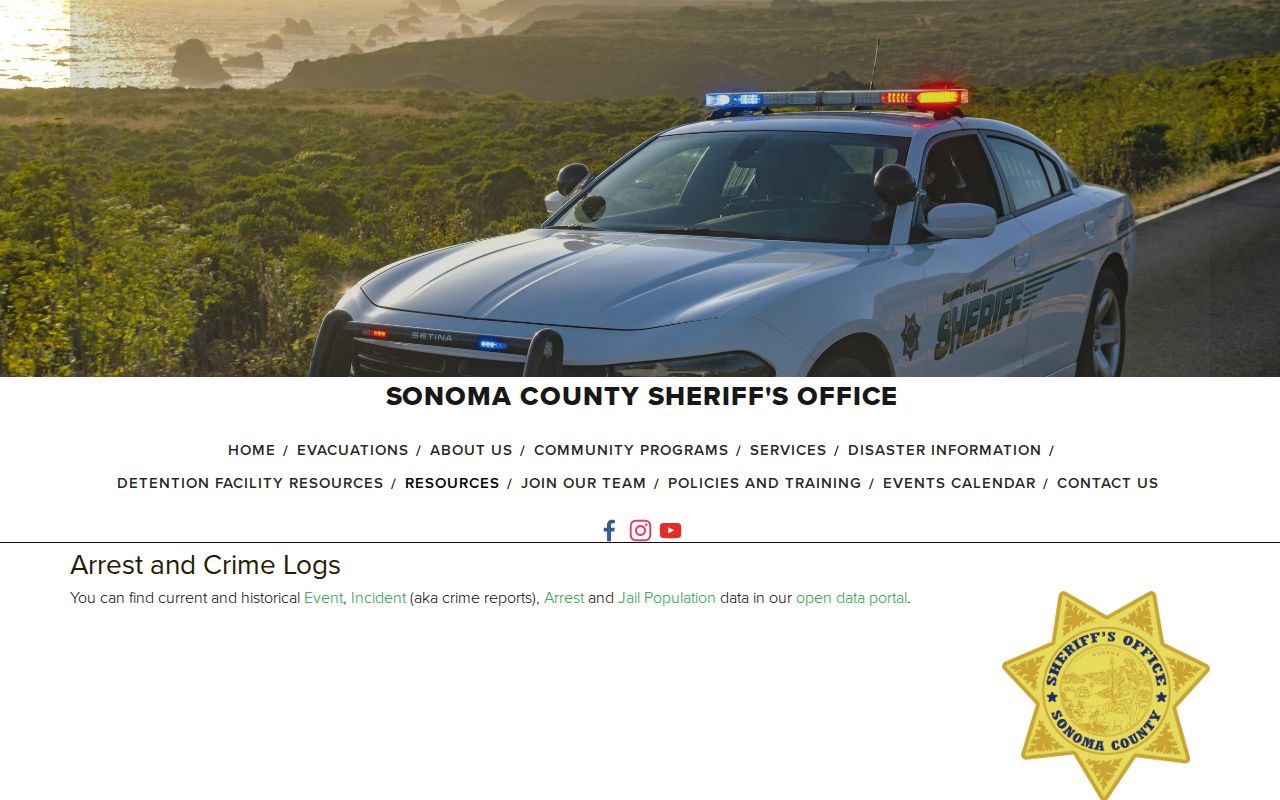
The link leads to source-owned data. Sonoma County keeps control of its own arrest records there. No commercial mirror sits in between. There is no saved list of names, either.
Read the Sonoma County Arrest Blotter
A good blotter search works backward from time, agency, and place. Start with the date. Then narrow by who made the arrest and where it happened in Sonoma County. Detailed columns keep agencies and events distinct.
- Open the county open-data record from the Sheriff’s logs page.
- Review Date & Time Arrested and work backward through the relevant period.
- Check Full Agency Name, agency abbreviation, arrest location, and city before treating the row as a Sheriff or city event.
- Compare the arrest number and incident number when similar names or repeated events appear.
- Use arrest degree, charge, and status only as event fields. Check Sonoma Superior Court for the later case result.
- If the record has rolled off, request it from the responsible agency rather than relying on an unofficial copy.
Need only the freshest rows? Sonoma Arrested Today is the better fit. It covers the same-day feed and booking lag. The deeper multi-day route is a separate question. Older records, city differences, and archive routing all belong here.
Note: Coordinates and an arrest location describe the published event, not where a person is held now.
Sonoma County Arrest Data Fields
The county open-data view is more granular than the Sheriff's visible arrest table. Each field describes the arrest event itself. No booking-photo field exists there. A current jail image, when one is available, comes from the separate inmate-search result.
| Field | How to read it |
|---|---|
| Full Agency Name / Agency | Identifies the reporting or arresting agency represented by the row. |
| Date & Time Arrested | Places the event in the multi-day sequence. |
| Arrest # | Identifies the arrest record in the source data. |
| Incident # | Connects the event to an agency incident reference. |
| Charge | States the charge entered at that stage, not the court outcome. |
| Location / City | Shows the reported arrest place and municipality. |
| Latitude / Longitude | Provides map coordinates tied to the event data. |
| Arrest Degree | Classifies the reported charge level in the dataset. |
| Arrest Status | Shows a source status value that can later change. |
The Sheriff's table is simpler. It shows a name with gender and age. Status and zone round out each row. Fewer fields mean fewer chances to mix up arrest events in Sonoma County.
Sonoma County City Arrest Reports
Sonoma County's three largest cities publish very different blotters. Santa Rosa Police maintains an ArcGIS layer limited to the last thirty days. Its fields cover date and time, arrest ID, case number, charge sequence and description, address details, identity fields, age, and arrest status. No photo field appears. That thirty-day boundary belongs to the city alone. Never apply it to the county dataset.
Petaluma Police runs an automated GIS arrest table. It lists date and time, incident number, charge description, location, full name, gender, age, status, and date of birth. The service warns that rows may be corrected, supplemented, modified, or removed as facts, law, policy, or court action change. It also calls the data informational, and no fixed day count or photo field appears.
Rohnert Park presents the clearest limit. The Department of Public Safety publishes no arrest blotter. Its Records Bureau is the right city route. Sonoma State University Police keeps a separate sixty-day arrest log. That university log cannot stand in for the city's.
The Santa Rosa Police arrest-log item documents the bounded city example within the wider Sonoma arrest-report landscape.
The city-owned layer answers to its own thirty-day scope. That window is a Santa Rosa rule. It says nothing about county-wide retention. Sonoma County's dataset keeps its own, unwritten bounds.
Weekend Sonoma County Arrest Reports
No official source lays out a weekend or holiday refresh schedule for the Sonoma County arrest dataset. Post-weekend row clusters can mean several things. Events may have been recorded during those days, or entered later, corrected, or filtered differently by the user. None of that is a surge. A surge claim needs counts and a comparison window. Check the event timestamp first. Then check the agency and status. A late-night arrest may not reach the current-custody roster until booking finishes, and city logs run on their own automated clocks, so an empty morning search settles nothing.
Weekend rows answer one question only: who was arrested in Sonoma County. For what prosecutors later filed, the Superior Court record is the place to look.
Older Sonoma County Arrest Records
A booking row can vanish from a public page long before the paper trail does. Behind every Sonoma County arrest entry sits an agency file, a booking sheet, or a court record. Each is kept on a retention schedule. A Sheriff detention record may drop off the roster or the open dataset. It has not been destroyed. Ask the Sonoma County Sheriff's Records Unit at (707) 565-2204. You can also file through the official report and public-record request page. The Sheriff promises an answer within ten days. Fees may apply first. There is no single published charge for booking photos. Ask for exactly what you want. A strong request names the person and the approximate arrest date. Add the agency and any arrest or incident number. City-police records stay with the city that made them. Case filings go to Sonoma Superior Court. The Sonoma Superior Court records page shows that separate official route for court records after an arrest report.
Court records tell you what happened in the case. They do not replace the agency's original arrest or detention file, which stands on its own. Each office holds a different piece. Note: A request may be limited by privacy, safety, sealing, juvenile-record, or other California disclosure rules.
Sonoma County Arrest News Limits
News adds color that rosters cannot. Patch Petaluma and Patch Rohnert Park-Cotati run selected arrest stories and repeat agency statements. The Press Democrat covers public safety across Sonoma County too. None of them is a complete arrest log. None is a custody roster or the final word from a courtroom. Publication there is story-driven, so coverage comes and goes. RecentlyBooked keeps a Sonoma County page, but it is an unofficial mirror that may be stale or incomplete. Lean on official sources first. County open data covers the event. The Sheriff roster shows current custody. Records units supply copies, and the court resolves the case. No third-party site should serve as the archive of record for Sonoma County recent arrests.
Correcting Sonoma County Arrest Reports
An arrest row online can change while the agency's own file stays put. Petaluma warns that its automated data may be modified, corrected, supplemented, or removed. New facts, laws, or policies can require it. So can court actions. County open-data status can also diverge from a later court result. Before you seek a fix, save the details. Keep the arrest number, incident number, agency, date, and the exact field in dispute. Route the error to the office that owns it. Event-data problems go to the agency that published or created the row. A Sheriff matter belongs with the Sonoma County Records Unit. Santa Rosa and Petaluma each handle their own events. Rohnert Park records go to its Public Safety Records Bureau. A charge or disposition error belongs with Sonoma Superior Court. This source-first path lets each office compare the public display against its official record. Fixing the official source is not instant. A news story or unofficial mirror may still show the old information. Use the official correction when asking a secondary publisher to review stale content. A row may disappear after correction. That does not prove the detention or court file was destroyed. Note: A changed public row and a sealed record are different, and sealing eligibility depends on California law and the court process.